Geography is just one aspect of a well-rounded social studies education, but it’s an important one. Especially because geography includes way more than looking at and labeling maps or memorizing states and capitals.
Deeply understanding geography helps your child understand the world around them—why cultural traditions develop the way they do, why people migrate, and how they adapt to and change their environment.
And when they develop this understanding, they also develop greater empathy and curiosity about the world around them.
That’s why it’s important not only to include geography topics and map-reading skills throughout your child’s homeschool journey, but also to use a dedicated geography curriculum.
In this post, I’ll break down what a solid geography education includes and how to build geography skills from elementary through high school.
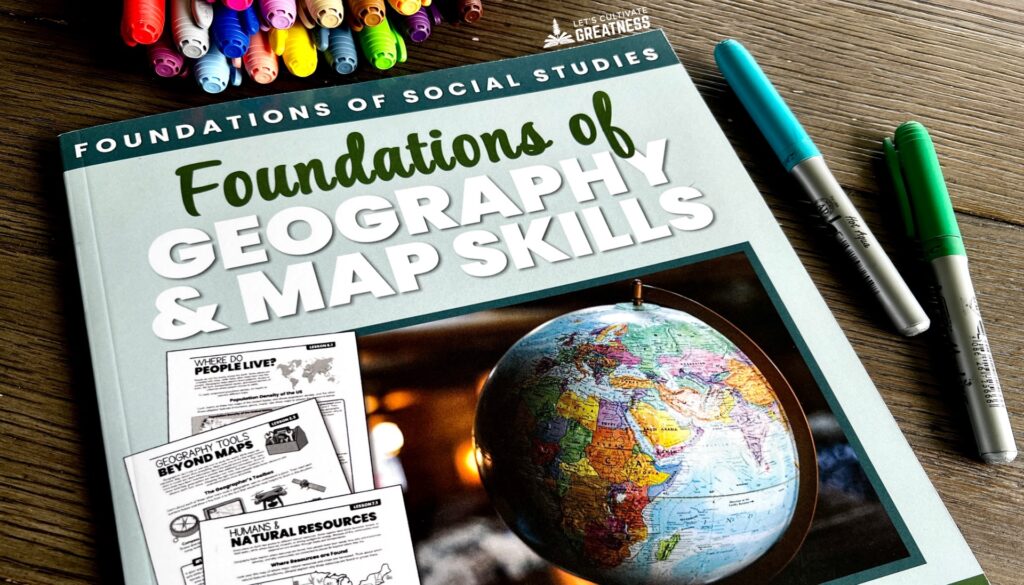
I will also preview my Foundations of Geography & Map Skills curriculum workbook, which I created to help upper elementary and middle school students develop those skills in a clear and easy way.
What all is included in learning Geography?
At its core, geography is the study of places and how humans interact with the world around them.
That means geography does include looking at maps and learning states and capitals, but it’s also much more. Generally, the three major aspects of geography are map-reading skills, physical geography, and human geography.
Map-reading skills include developing spatial thinking, identifying map components, learning cardinal and ordinal directions, understanding and using different types of maps, and using other geographic tools such as GPS and aerial imagery.
Physical geography focuses on the natural world: landforms, climate, bodies of water, ecosystems, and natural resources.
Human geography focuses on people and society: population, culture, migration, urban development, and how humans adapt to and change their environment.
Ultimately, geography is about understanding patterns across places and over time—and the connections between humans and the world around them.
A great geography curriculum will help your child answer questions like: Why did cities develop where they did? How do climate and the landscape shape how people live? Why do people migrate from one place to another? Where do cultural traditions come from?
These are the kinds of questions that geography helps students explore—and they’re exactly what make geography such an important part of social studies.
Building Geography Skills From Elementary Through High School
Geography skills are best built over time, with each stage preparing students for more complex thinking later on.
Like other social studies disciplines, geography should be revisited throughout the years to both reinforce foundational skills and knowledge and dive into deeper geographic topics.
In the early elementary years, geography begins with spatial thinking and basic map awareness. Things like making simple maps to scale, learning cardinal directions, continents, oceans, and about cultural holidays around the world.
Upper elementary is a perfect time for a more structured geography curriculum because the brain is developing more abstract thinking and spatial understanding skills. It’s a great time to learn core aspects and how they interact: regions, major landforms, climate zones, and natural resources. This is often when many homeschool families cover U.S. geography.
Middle school learners are ready to expand outward into world geography and cultural understanding. That’s why middle school geography curriculum often focuses on learning about countries and regions around the world, including major physical features and cultural characteristics.
In high school, geography becomes even more analytical, focusing on human geography topics like urbanization, migration, globalization, population growth, and natural resource use. Geography becomes a tool for understanding real-world challenges.
When geography is taught in this progressive way, students develop far more than memorization skills. They learn to think spatially, analyze patterns, strengthen map-reading skills, interpret data, and better understand the world around them.
A Geography Curriculum Designed for Upper Elementary or Middle School
If your child is in the upper elementary to middle school range and you’re looking for a homeschool geography curriculum that builds strong geography skills and understanding, check out my Foundations of Geography & Map Skills curriculum workbook.
This is the perfect material to give your child a strong, well-rounded foundation to geography concepts and skills before diving into U.S. geography, world cultures, or human geography coursework.
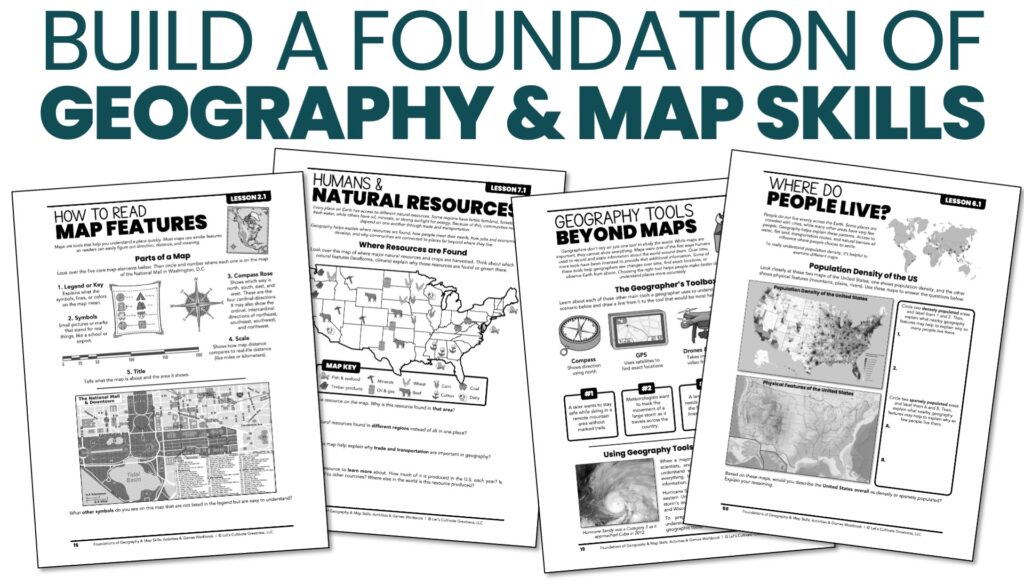
The workbook lays a strong foundation in basic skills and shows how geography connects to the real world, making it perfect for this transition to deeper learning.
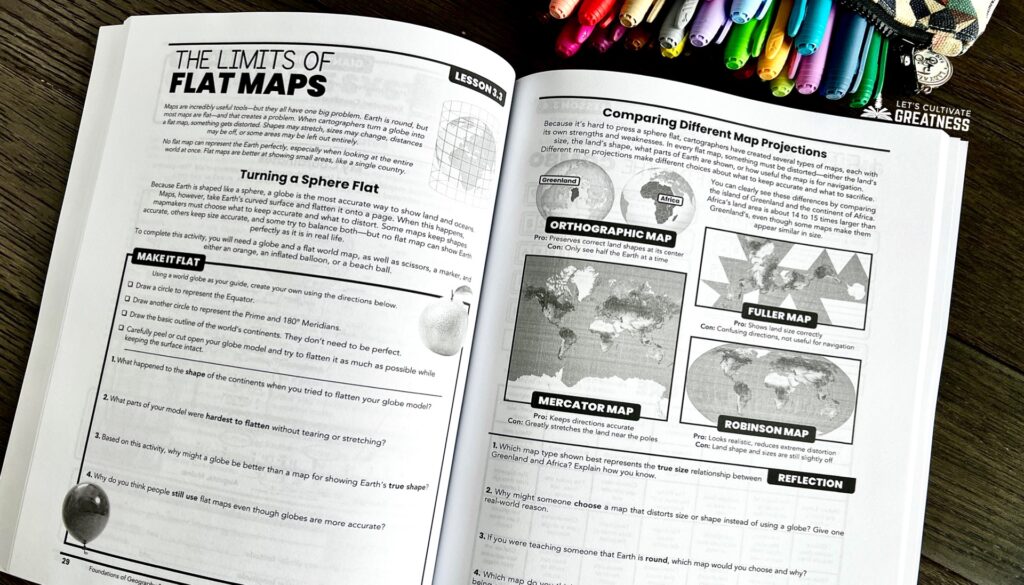
It’s organized into seven chapters, each with a short informational reading, followed by a variety of guided activities ranging from interpreting real maps to researching local geography, critical thinking questions, review games, and a test at the end.
Topics covered include: what is geography, how to read maps, the global coordinate system, the five themes of geography, types of landforms and bodies of water, why people settle and move where they do, and how people use natural resources and adapt to natural hazards.
It also emphasizes discussion, comparison, and deeper thinking about concepts and real-world examples.
Whether you use it as its own geography curriculum or alongside other social studies resources, it’s designed to be flexible, open-and-go, and easy to adapt to different learning styles and schedules.
To take a closer look inside the workbook, check out my flip-through video below.