
Vocabulary instruction often shifts once students reach middle and high school. As students dive into deeper content vocabulary—osmosis, oligarchy, onomatopoeia—we tend to stop intentionally teaching general academic words like augment, audacity, or arsenal.
But a college- and workforce-ready vocabulary depends just as much on those high-frequency academic words as it does on subject-specific terms. That’s part of what it truly means to read and write at an 8th-, 10th-, or 12th-grade level.
The middle and high school years are the perfect time to build that broader academic vocabulary through structured, consistent practice. These are the words students encounter across subjects—in literature, history, science, and real-world news and conversations.
It’s also important to know that whether you’re teaching in a classroom or homeschooling, effective vocabulary building is two-fold: finding appropriate words and using effective strategies to practice them.
In this post, I’m sharing how to do both—and a ready-to-go vocabulary curriculum for middle and high school that follows this exact approach.
Why Vocabulary Building Still Matters in Middle & High School
MStrong reading, writing, and speaking skills depend on a rich word bank. Students who know higher-level academic words are better equipped to analyze what they’re reading, understand directions, and express ideas. These skills matter immediately in school and later in adulthood.
Academic Success
Understanding high-frequency academic words means being able to tackle complex texts more easily across subjects. These are also the kinds of words that appear on standardized tests such as the SAT® and ACT®, which now place greater emphasis on broad academic language than on obscure vocabulary.
Speaking and Writing More Clearly
Middle and high school students are expected to develop precise positions on topics and explain their thinking. A broad vocabulary gives them options. Instead of saying something was “good” or “bad,” they can describe it as “benevolent” or “abhorrent.” That precision strengthens both academic writing and everyday communication.
College & Workforce Readiness
Success after high school hinges on managing college textbook readings, job training programs, interviews, and workplace communication without confusion or hesitation. A well-developed vocabulary reduces confusion, increases clarity, and helps students adapt to new environments more quickly.
What Vocabulary Building Strategies Actually Help New Words Stick?
Knowing how to teach vocabulary involves seeing it as a two-part process: creating a vocabulary-rich environment (whether in your classroom or at home) and deliberate practice. First, let’s look at five simple strategies you can start using right away to tackle the first part.
1. Read Widely at the Right Level
The easiest way to grow vocabulary is through consistent reading. Encourage your students to read grade-level books and news stories, and even listen to podcasts. Local newspapers are often written around a 9th–10th grade level, while national ones tend to run closer to 10th–12th grade. That makes them a surprisingly good gauge for academic vocabulary exposure.
The more students encounter high-frequency academic words in the real world, the more naturally they become part of their vocabulary.
2. Look Up Words in the Moment
When students come across an unfamiliar word, pause and look it up. Not later. In the moment.
Whether you’re teaching in a classroom or sitting at the kitchen table, modeling this habit sends a powerful message: knowing what words mean matters. Over time, they will do this themselves—and, hopefully, will continue this habit throughout their lives.
3. Choose a Word of the Day (or Week)
Designate a word of the day or word of the week and keep it visible. Write it on the board or post it on the fridge.
Return to it throughout the day. Use it in conversation. Challenge students to use it correctly in speech or writing. Repetition spaced across time is one of the most effective ways to make vocabulary stick.
4. Upgrade Ordinary Words
When a student says something was “good,” ask: Can we be more precise?
Swap vague words for sharper ones. “Good” might become beneficial. “Bad” might become detrimental. This practice strengthens both vocabulary and thinking, as students must consider nuance rather than default to general language.
5. Identify Similar and Opposite Words
When a new word is introduced, don’t stop at the definition. Ask: What’s a similar word? What’s the opposite?
Thinking in terms of word relationships builds deeper understanding. It also prevents students from memorizing a definition without truly grasping how the word functions in real language.
A Simple 5-Step Vocabulary Building Routine
In addition to creating a vocabulary-rich environment, it helps to formally practice new words. After identifying an academic word, use these five research-backed steps to study it more deeply.
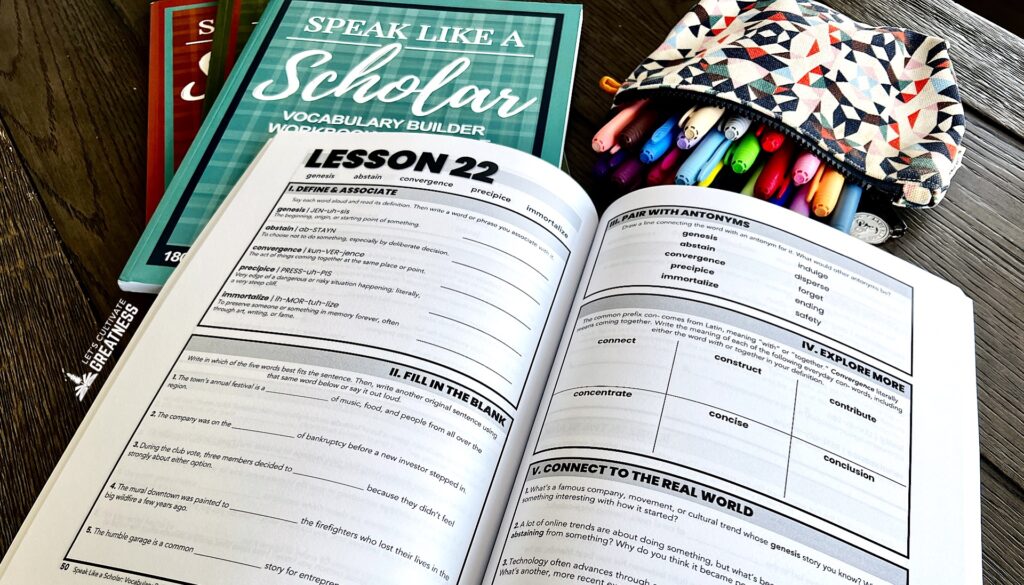
This is the exact weekly routine I’ve used with my own students—and it’s the structure behind my vocabulary builder workbooks as well.
Step 1: See the Word in Context
Start by examining the word exactly as you encountered it—in its original sentence. Seeing how the word functions in real language gives students clues about tone, meaning, and usage that a definition alone cannot provide.
Step 2: Define and Clarify Meaning
Look up the definition, but don’t stop there. Have students restate the meaning in language that makes sense to them. When students translate a definition into their own words, they process it more deeply and are far more likely to remember it.
Step 3: Practice with Synonyms & Antonyms
Next, widen the lens. What words mean something similar? What words mean the opposite? This step builds word networks in the brain, helping students see nuance and understand how vocabulary choices shift tone and meaning.
Step 4: Create a New Sentence
Have your students create their own sentence that shows they truly understand the word, not just mimic the dictionary definition. The goal is application. When students actively use a word, they move it from short-term recognition to long-term ownership.
Step 5: Make It Personal or Real-World
Finally, help them answer: What can I describe about my life or the real world that uses this word? Making a personal or real-world connection cements the word in a meaningful way.
An Open-And-Go Vocabulary Curriculum for Middle & High School
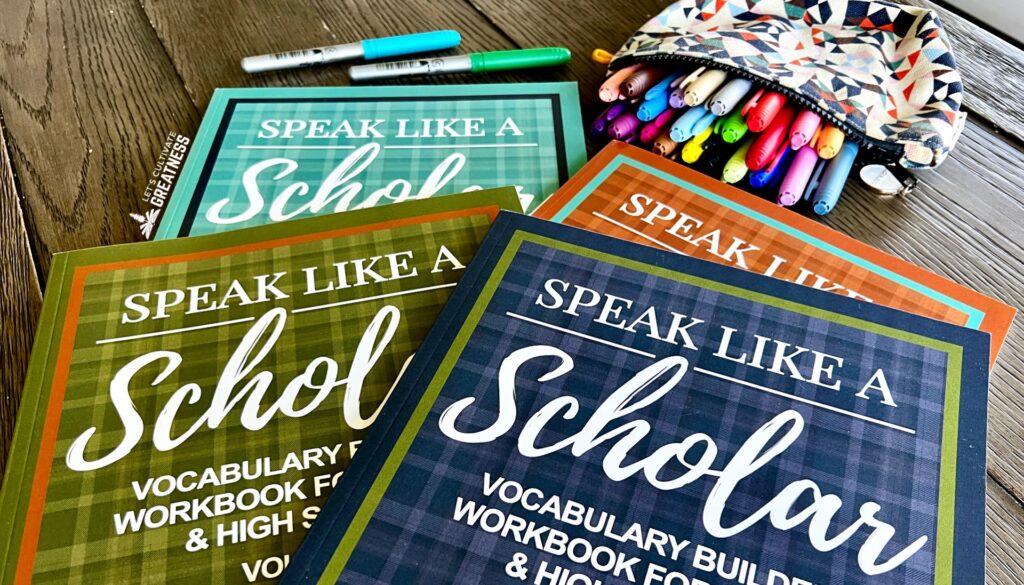
If you’d like a ready-made vocabulary curriculum designed for middle and high school, check out my four-year vocabulary builder workbook series.
Each book teaches 180 grade-level-appropriate words using the same five-step routine in an easy, open-and-go weekly or daily format.
To get a closer peek inside, check out my flip-through preview below.