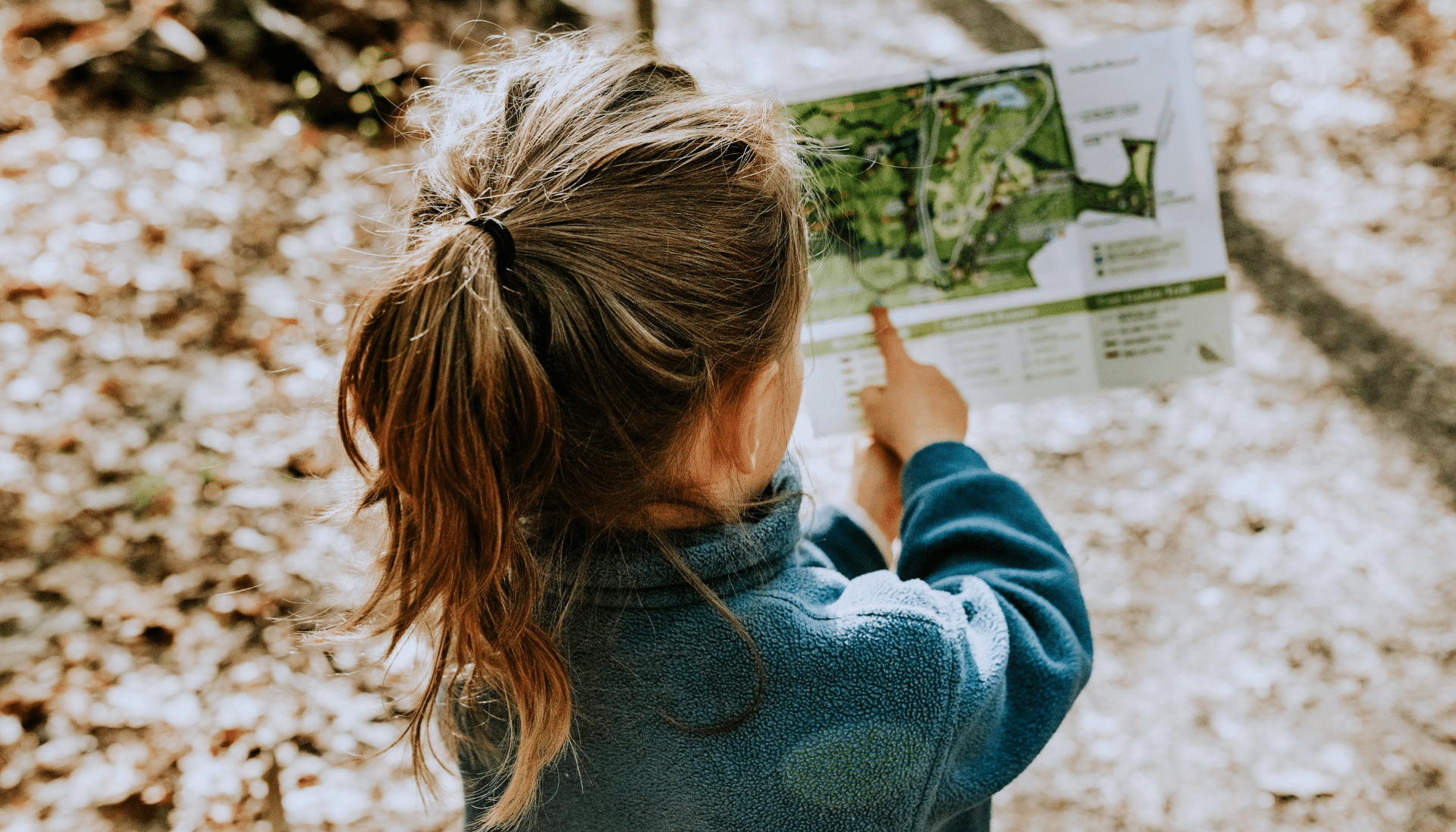
Learning history or social studies can quickly become information-heavy. Read a chapter (or watch a video), answer questions, then move on. Even great homeschool curriculum can fall into that repetitive cycle.
So, if your kids are complaining that their social studies is boring, this may be why. Social studies is about real people, places, choices, and how everything connects. So only reading about these things will totally feel… well… flat.
That’s why the best way to learn social studies is to actually do it. Map your neighborhood for geography, create a grocery budget and compare prices for economics, or research candidates in an upcoming election for civics.
By actively exploring what they’re learning, your kids will ask questions, make connections, consider different perspectives, and think critically about the world around them.
Just one thoughtful conversation about how a topic relates to your child’s life can make a difference.
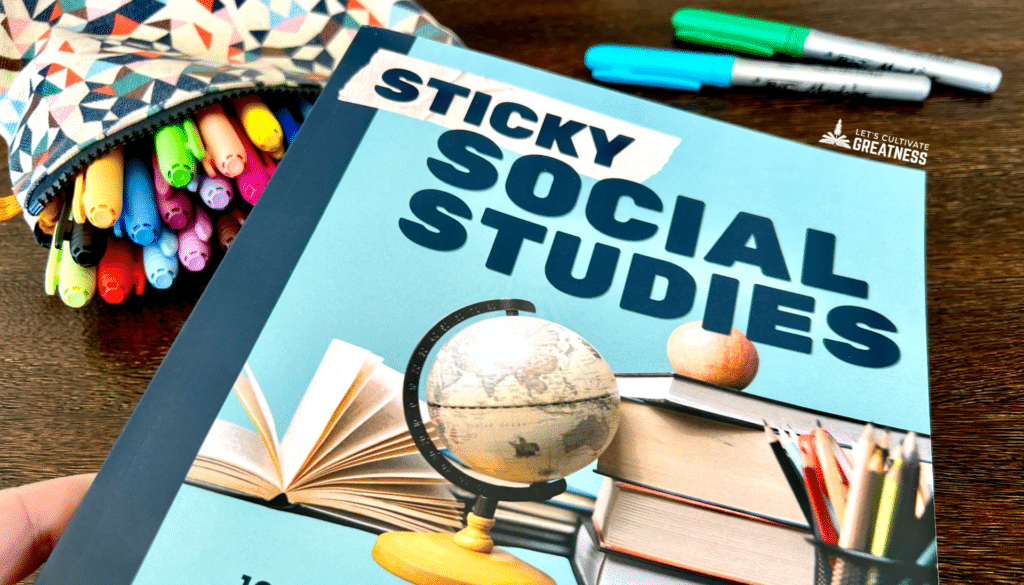
In this post, I’ll share a few of my favorite (and easy!) social studies activities that work for all ages, along with a look inside my Sticky Social Studies: 100 Hands-On Ways to Teach Geography, History, Civics, and Economics for Homeschool Families, which will help you bring more active, real-world learning into whatever social studies curriculum you already use.
What Does Social Studies Actually Include?
When most people hear social studies, they immediately think of history. But social studies is an umbrella that includes several fields focused on understanding people, places, societies, and how they interact.
The four core areas:
Geography explores places and environments, including how land, climate, resources, and human activity shape where and how people live.
History examines the past—how people lived, events that shaped societies, and their lasting effects.
Civics and government explore how communities and countries organize themselves, make laws and decisions, balance rights and responsibilities, and how citizens participate.
Economics examines how people make choices with limited resources, including how individuals, businesses, and governments produce, buy, sell, save, spend, and make decisions.
You likely have seen that many social studies curricula weave bits of geography, civics, and economics into a mostly history-based course.
But that isn’t the same as giving each discipline its own focused study.
Geography, civics, economics, and history each offer a different lens for understanding the world—and each deserves time in the spotlight. I can’t recommend it enough that you dedicate time to exploring each on its own throughout your homeschool journey.
Try These 10 Social Studies Activities at Home
Here are 10 simple ways to bring geography, history, civics, and economics to life—most with little prep and using things you already have at home.
1. Build (and Break) a Globe – Get a balloon, beach ball, or even an orange and have your child draw a basic globe. Outline the continents and add the Equator and Prime Meridian, plus other features like oceans and continents.
Talk about where you live, latitude and longitude, and places on opposite sides of Earth. Then comes the fun part—pop, peel, or carefully cut it apart and try to flatten it. Why is it impossible to do this without cutting or stretching the surface? What happens to the shapes and sizes of places? How do different maps show the world differently because of this?
2. Shape the Land – Get some playdough and have your child create the different landforms such as a peninsula, plateau, basin, or island. Or create a 3D model of where you live or the place they are studying.
Then think about how the land affects people. Where would you build a town or road? Where might farming be easiest? How do mountains, rivers, or coastlines affect travel and settlement?
3. Explore a Local Landmark – Select a local geographic feature that draws visitors, such as a national park, popular beach, or a seasonal bloom. Research how it formed and how it became a tourist destination.
Then visit in person and connect what your child sees to what they learned. Talk with park rangers or tour guides, and notice nearby businesses and jobs supported by all the visitors. Consider both sides: How does tourism benefit the area, and what problems can too many visitors create?
4. Research a Public Works Project – Look for an older government-built project that still exists in your community—a bridge, dam, mural, park, or historic building. If you’re studying the Great Depression, search specifically for nearby New Deal projects from the 1930s. The Living New Deal website is a great place to start.
Research who built or funded it, why it was created, and visit if you can. Why might a government build projects like this during an economic crisis? How did the project affect your community then, and how does it still affect people today?
5. Interview an Older Generation – Have your child interview an older relative, neighbor, or other trusted adult about life when they were younger. Ask about school, technology, family life, or historical events they remember, and encourage asking follow-up questions, not just those from a written list.
Afterward, compare their experiences with what your child has learned about the time period. What can a personal story tell us that a textbook cannot? How was this person’s life shaped by when and where they lived? What surprised you about what has changed—or stayed the same?
6. Meet Your Representatives – Help your child find your two U.S. senators and House representative using official .gov websites. What issues do they focus on? What committees do they serve on? How can constituents—including you—contact them?
Then look at your state’s congressional district map. Why do congressional districts have different shapes and sizes?
7. Visit a Courthouse – Find your local or nearest federal courthouse and see whether it offers tours or allows visitors to observe public proceedings. If possible, sit in on a session and notice where everyone is, who speaks, how the judge maintains order, and the procedures and vocabulary used.
Afterward, discuss: How was the real courtroom different from what you’ve seen on TV? Why do courts follow such structured procedures? What did you learn about the judicial branch and rule of law?
8. Take the US Citizenship Test – Find the official U.S. naturalization civics questions and see how many your child can answer. Use missed questions to identify gaps in their knowledge, then choose 20 or so to create your own mini citizenship test.
Then dig deeper: Which questions should every U.S. citizen be able to answer? What important things about citizenship or government doesn’t the test measure? What does it mean to be an informed citizen?
9. Incentives Everywhere – Introduce the economic idea that people respond to incentives—things that encourage us to act (or not act) in a certain way. Brainstorm everyday examples such as sales, loyalty rewards, grades, prizes, consequences, or personal goals. Sort them into external incentives (rewards or consequences) and internal incentives(pride, curiosity, enjoyment, or personal growth).
Why do incentives work? What might cause one to backfire? How do businesses, governments, and families use incentives to influence choices?
10. Plan a Week of Groceries – Put your child in charge of planning and pricing a week’s worth of groceries. Choose meals, check what you already have, and use grocery ads, apps, or websites to price the rest. Give them a realistic budget and have them compare brands and unit prices, look for sales, and make substitutions as needed.
Which choices saved the most money? When is the cheapest option not the best choice? What trade-offs did you make to stay within budget?
100 Hands-On Ways to Teach Social Studies
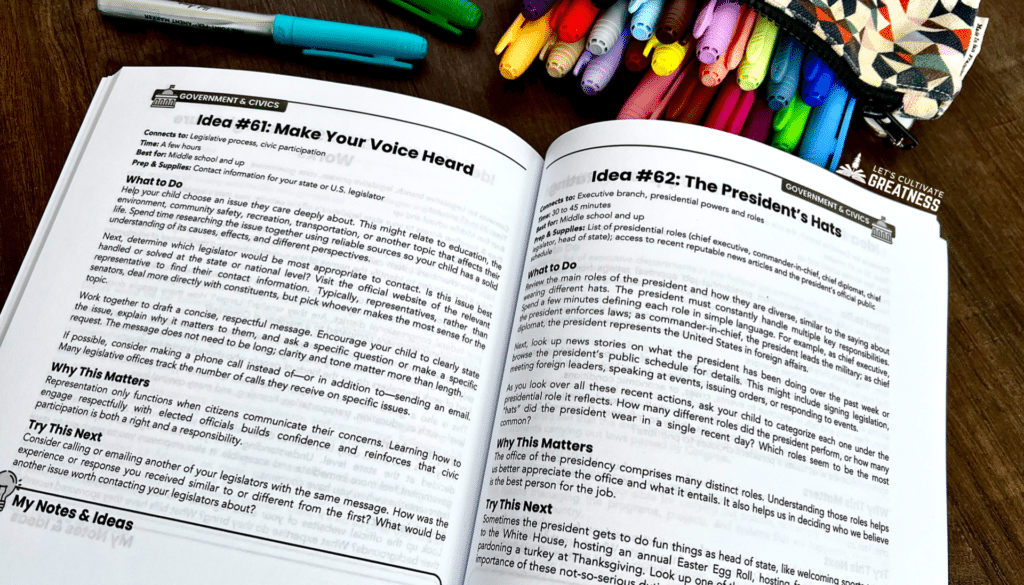
If these activities sound like the kind of social studies you want in your child’s homeschool experience, Sticky Social Studies gives you 100 of them—25 each for geography, history, civics and government, and economics.
Each activity includes directions, suggested ages and time needed, discussion questions, and ideas for extending the learning.
Think of it as a toolbox to use with the curriculum you already have. Pair activities with what your child is studying or pick one whenever you need a change of pace.
The best part is that you’ll use it year after year.
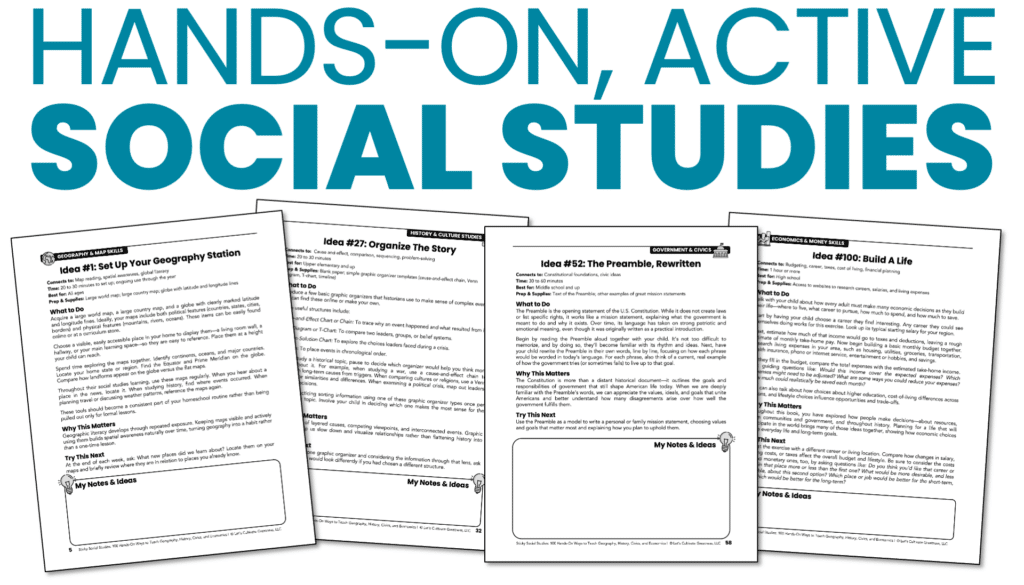
You can pick one to do each week or simply pull it off the shelf when you need something different; it’s designed to be flexible, low-prep, and easy to fit into the homeschool curriculum you already use.
To take a closer look inside the book, check out my flip-through video below.