Economics is an important part of a social studies curriculum sequence—but it can be overlooked, thought of as only a high school elective, or assumed that just personal finance topics are enough.
However, economics is central to understanding human behavior because it’s the study of how people make decisions about life, resources, and money. And like geography or civics, economics skills build gradually over time and should be revisited throughout elementary, middle, and high school.
Having a strong economics component in your homeschool social studies curriculum helps your child strengthen critical thinking, decision-making, and financial literacy skills.
That’s why it’s important to do more than discuss budgeting, saving, and money topics in isolated lessons, but to include dedicated economics instruction throughout your child’s homeschool journey.
In this post, I’ll break down what a solid economics education includes and how to build economics and money skills from elementary through high school.
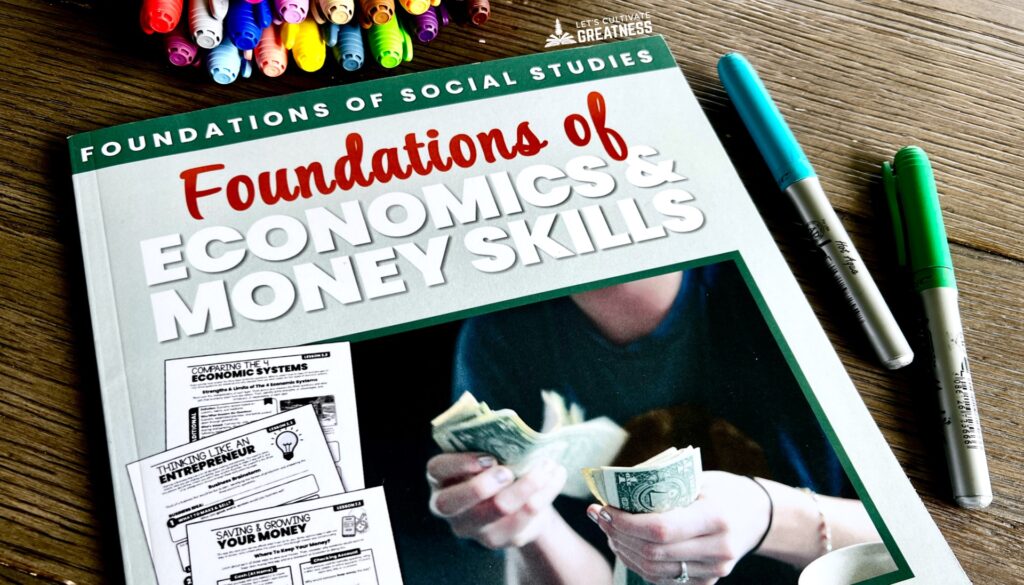
I will also preview my Foundations of Economics & Money Skills curriculum workbook, which I created to help middle school students develop those skills in a clear and easy way.
What all is included in learning Economics?
At its core, economics is the study of how people make decisions with limited resources.
That means economics does include topics like money, saving, budgeting, and markets, but it’s also much broader than that. Economics helps students understand how individuals, businesses, and governments make choices and how those decisions affect everyday life.
Generally, these are the core areas that should be covered:
Scarcity and decision-making, including understanding needs versus wants, trade-offs, opportunity cost, incentives, and why people must make choices when resources are limited.
Markets and economic systems, including supply and demand, prices, production, jobs, wages, entrepreneurship, and the flow of goods and services through society.
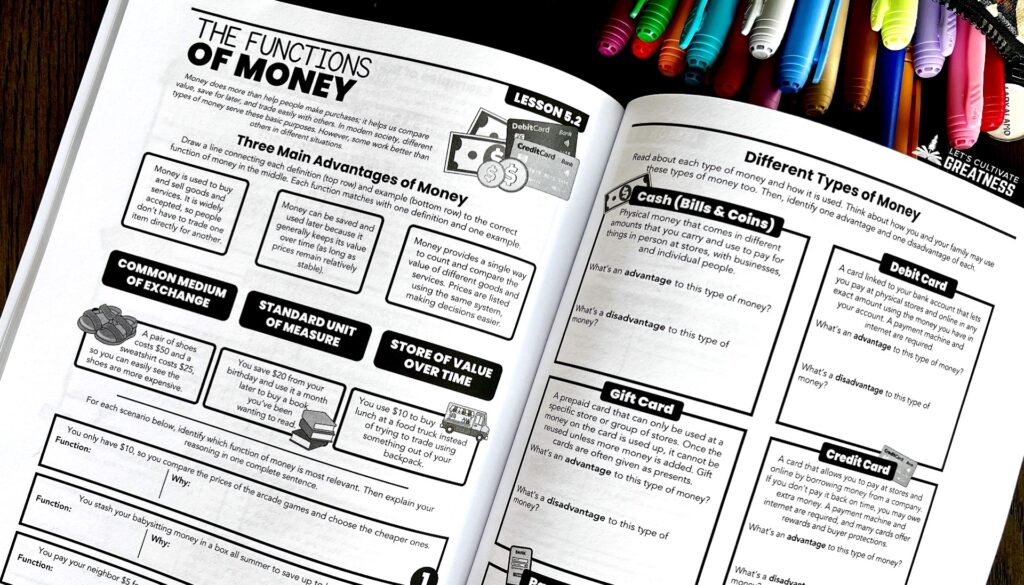
Money skills and financial literacy, including saving, spending, budgeting, taxes, credit cards, and making thoughtful financial decisions.
Ultimately, economics is about understanding choices, systems, and how money and resources move through society.
A strong economics curriculum will help your child explore questions like: Why do prices rise and fall? Why do shortages happen? Why do some jobs pay more than others? How does advertising influence decisions? How do governments affect the economy?
These are the kinds of questions that economics helps students think through—and they’re exactly what make economics and financial literacy such important parts of social studies.
Building Economics & Money Skills From Elementary Through High School
Economics and money skills are best built over time as your child becomes able to make more advanced decisions and think more deeply about decision-making.
This is why, like other social studies disciplines, economics really should be revisited throughout the years to both reinforce foundational concepts and explore deeper economic issues and financial skills.
In the elementary years, economics begins with simple ideas about needs and wants, counting money, and saving versus spending. This is a great time to discuss choices and alternatives, the costs of things, and making decisions with money.
Middle school is the perfect time to introduce basic consumer and entrepreneurship skills because students are developing problem-solving thinking and often become interested in making and spending money. This is a great stage for learning about scarcity, the basics of supply and demand, producers and consumers, earning money, and tracking expenses.
High school learners are ready to think more deeply about how economies function and how financial decisions affect daily life. That’s why the high school economics curriculum often focuses on macroeconomics and fiscal policy, current economic issues, supply-and-demand graphs, labor, as well as budgeting, taxes, and investing.
When economics is taught in this progressive way, students develop far more than just basic money skills. They learn to think critically about choices, analyze incentives and consequences, and make more informed financial decisions in everyday life.
An Economics & Money Skills Curriculum Designed for Middle School
If your child is in middle school and you’re looking for a homeschool economics and financial literacy curriculum that builds strong decision-making and real-world money skills (or is in high school and needs a quick review), check out my Foundations of Economics & Money Skills workbook.
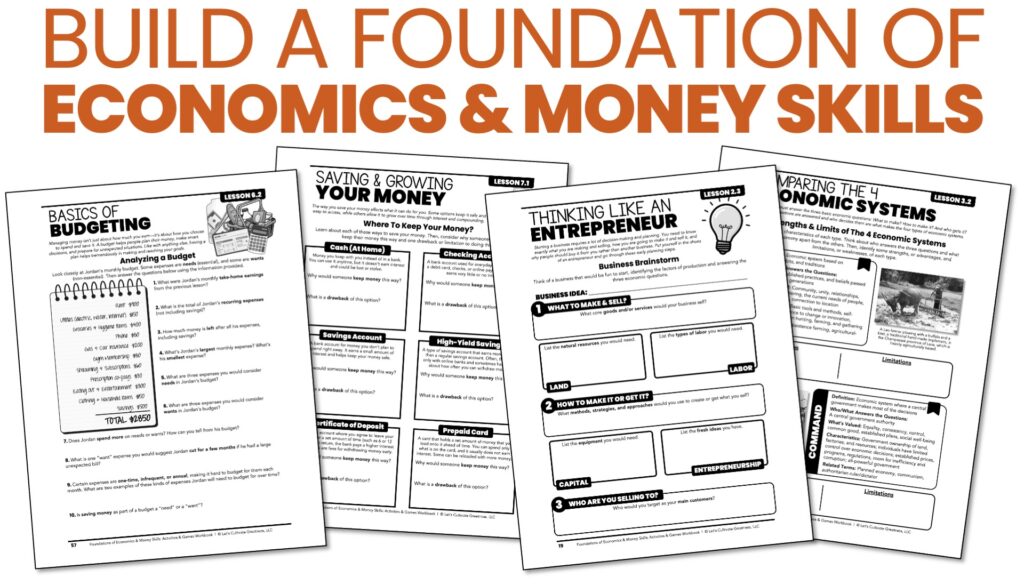
The workbook lays a strong foundation in economics and personal finance skills and shows how economic thinking connects to the real world, making it perfect for this transition to deeper learning.
It’s organized into seven chapters, each with a short informational reading, followed by a variety of guided activities ranging from simulating entrepreneurial decision-making to researching local banks, critical-thinking questions, review games, and a test at the end.
Topics covered include: scarcity and the basic problems of economics; goods and services; types of economic systems; supply and demand; markets and prices; banking and money; budgeting and spending; saving and investing; and how the larger economy works.
The activities break down abstract economics concepts into manageable lessons that help your increasingly independent middle school learner connect them to things they already experience: shopping decisions, advertising, shortages, prices, and saving money.
Whether you use it on its own or alongside other social studies curriculum, it’s designed to be flexible, open-and-go, and easy to adapt to different homeschool approaches.
To take a closer look inside the workbook, check out my flip-through video below.