Foundations of Economics Unit
$29.95
Introduce seeing the world through an economist’s lens to your students with this highly engaging, simulation- and real-world-filled 3-4 week Intro to the Foundations of Economics unit.
Included are over 20 activities, simulations, and projects to develop stronger decision-making skills and asks, “How can I start thinking like an economist?”
Description
This unit can be done well in 3-4 weeks and supports standards from various states.
Students will master key economic concepts like:
- scarcity, choice, incentive, need, want, utility
- micro- & macroeconomics
- paradox of choice & paradox of value
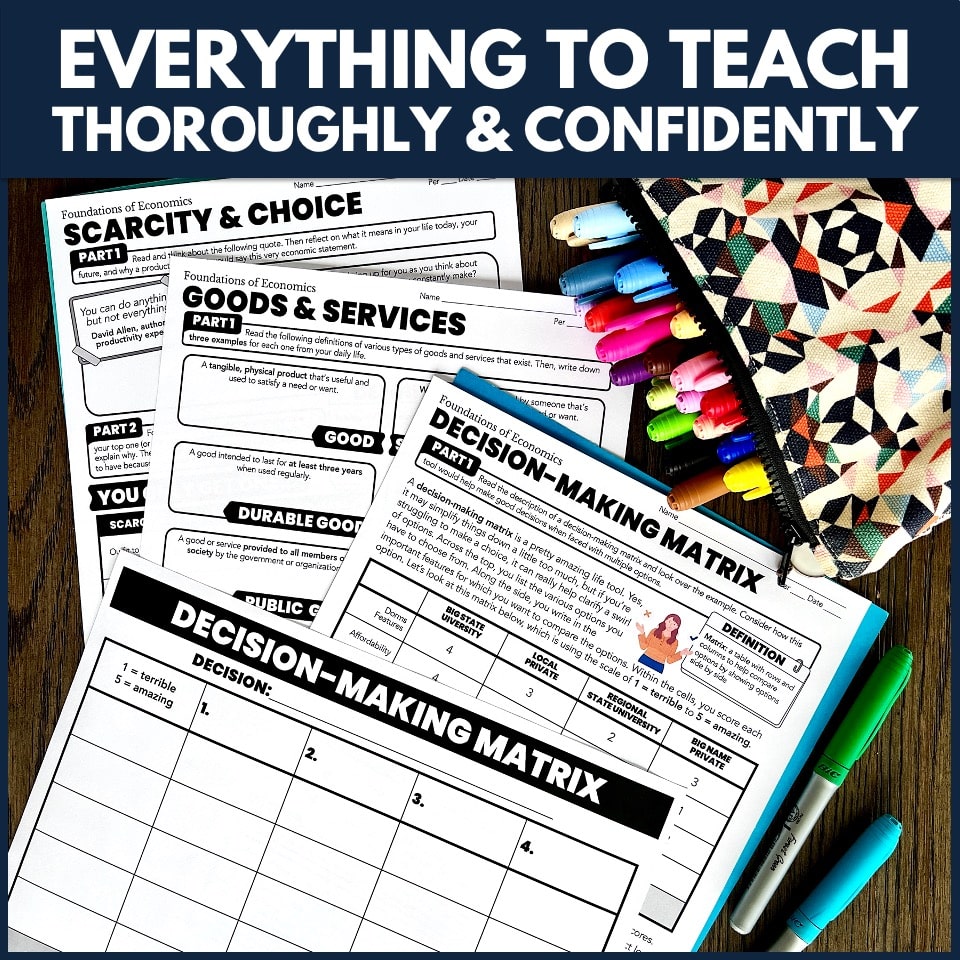
- decision-making matrix
- good, service, durable/nondurable good, budget/luxury good
- opportunity cost, production possibilities frontier, cost-benefit analysis
- 4 factors of production like land, labor, capital, & entrepreneurship
- 3 basic economic questions of production
Included in this Foundations of Economics Unit:
Overview Materials
- Teacher Unit Overview with general notes, links, standards, and a pacing guide
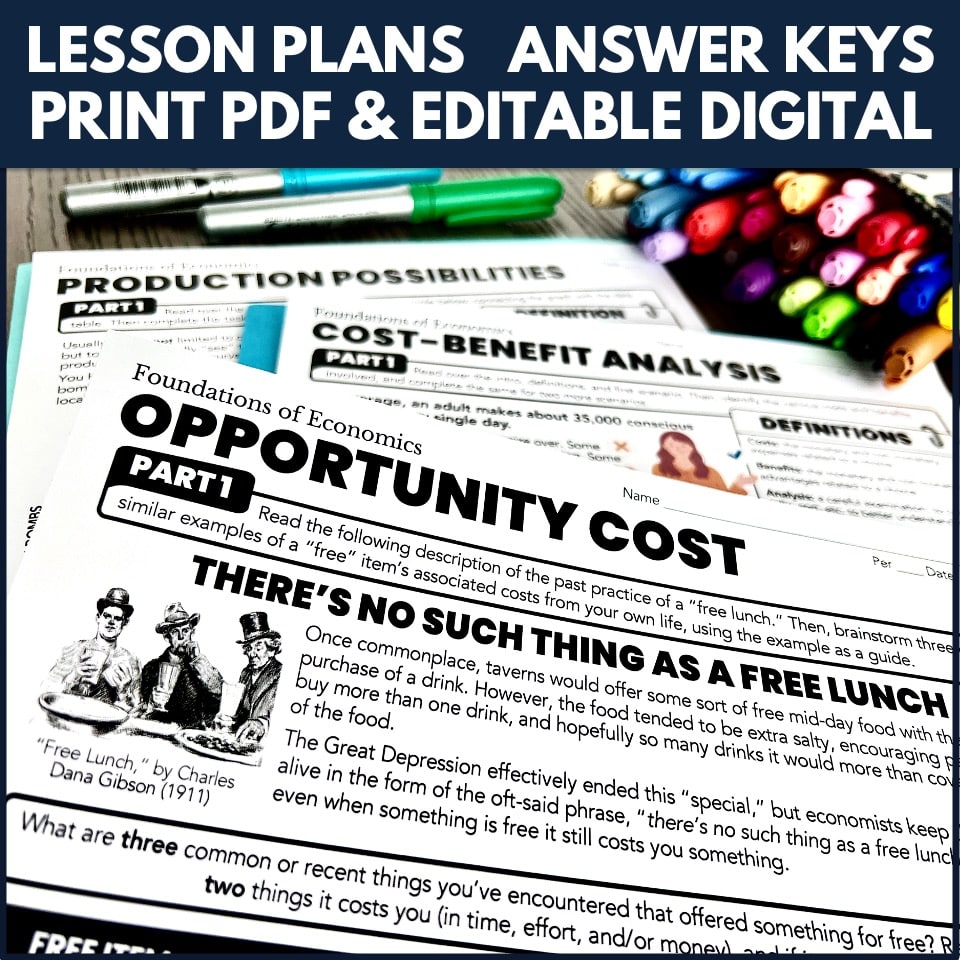
- Daily Lesson Plans with step-by-step details, planning, and lesson takeaways
- Detailed Answer Keys for each activity
- Unit Essential Questions and Standards handouts with review questions and “I Can…” checklists
- Concept Notes sheet for building deep and nuanced mastery of concepts
- Bell Ringer slides to introduce each activity
Major Topics & Activities
- Scarcity & Choice: Pack a suitcase, plotting needs and wants along a continuum line; run a simulation using lollipops;complete decision-making matrices; and explore behavioral economic concepts like paradox of choice and value
- Opportunity Cost, Production Possibility Frontier, & Cost-Benefit Analysis: Brainstorm and apply concepts to real-world examples, find PPF with a paper airplane simulation, run personal cost-benefit analyses, play the role of a CEO and various stakeholders in a CBA simulation
- 4 Factors of Production & 3 Economic Questions: Brainstorm and apply concepts to real-world examples, become an entrepreneur to develop a unique value proposition, conduct an incubator simulation to track factors of production, input costs, and UVP
- Scarcity in Real Life: 8-Station rotation activity of various scarce resources and how people make choices on how to allocate them
- Review Activities & Matching Card Games: 4 worksheet games/activities, and a 36-card deck for matching/sorting (8 game ideas included)
Lecture Kit
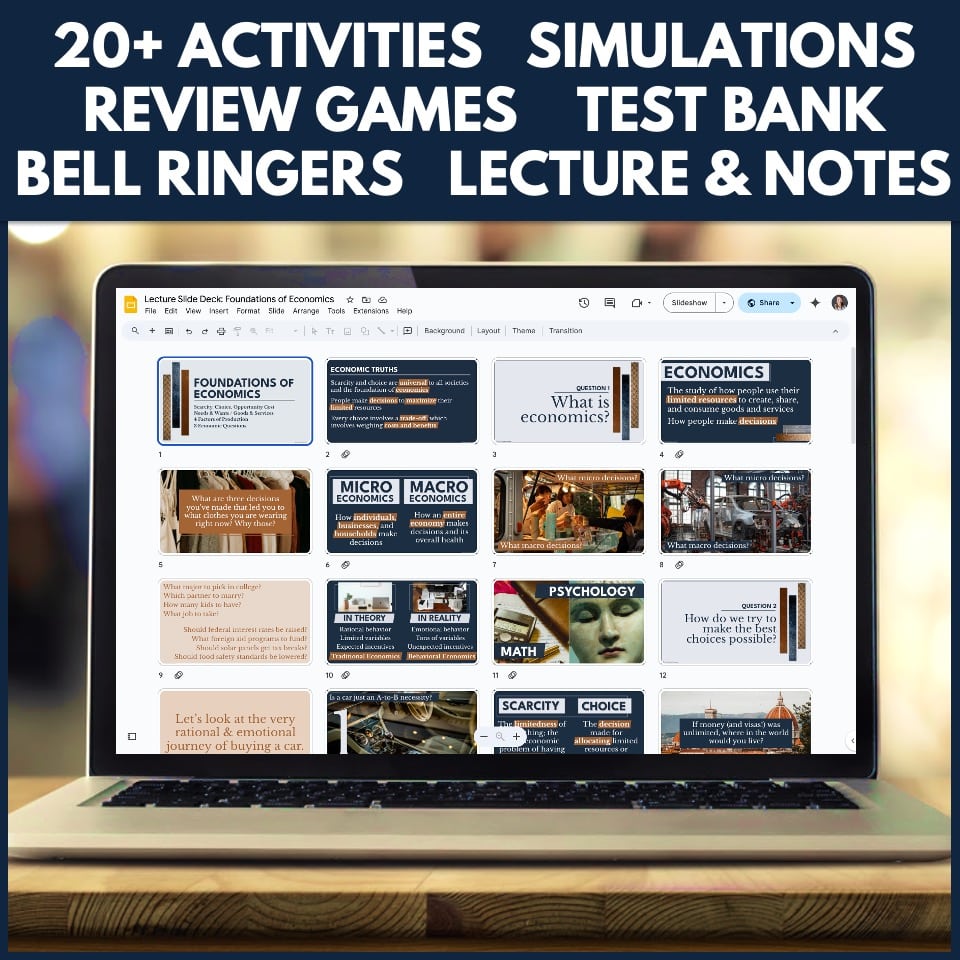
- 57-Slide Deck: introduce concepts with images and real-life examples; broken into three 20-30-minute sections to deliver throughout the unit
- Guided Notes & Test Bank: support and assess learning with these no-prep tools
- Extensive Speaker Notes & Handout: extended explanations and examples, both embedded in the slide deck and a separate handout
Outside Materials: These are listed at the beginning of the unit and in detail within the individual lesson plans. They include:
- A large bag of small lollipops
- Small paper lunch bags
- Regular letter-sized paper for origami folding
- Recent news articles
- Assortment of “building” supplies like cardboard, string, straws, scissors, tape, and markers
This bundle includes 140 PDF pages, plus Google files.
What grades is this intended for?
This was designed for high school, but some included resources could still work for upper middle school, especially if are willing to customize things as necessary.
What supports are included? How can I modify this?
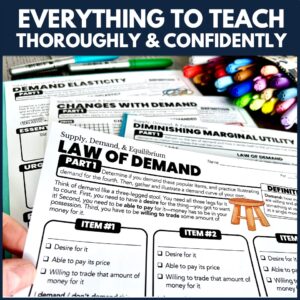
All sorts of supports are included in each activity, like graphic organizer notes, visuals, and definitions, and the lecture slides are designed with clear, focused content on each slide.
Google versions of student materials and lecture slides are editable to tailor for your students’ needs.
Is this editable? What file types does this resource come in?
The main resource is a secured, non-editable PDF file intended to be printed.
Included are links to editable Google files, to customize to your classroom needs and assign digitally if you choose.
What standards does this address?
Several! Standards vary, but this resource supports these from various states:
- Explain why scarcity and choice are basic economic problems faced by every society
- Explain the concepts of opportunity costs, trade-offs, and cost-benefit analysis
- Interpret a production-possibilities curve
- Describe how societies answer the basic economic questions and the economic factors of production
- Differentiate between needs and wants and goods and services; explain the role they play in economic decisions
- Describe how incentives and emotions affect decision-making
What are the terms of use for this resource?
This resource, including all ancillary files, may be used as needed for regular, non-commercial single-classroom use between a teacher and their students.
This includes printing copies and sharing digital files with students through a secure platform, like Google Classroom or Canvas, email, or a classroom-only shared drive.
The using and sharing of any part of this resource in any manner outside the above-mentioned capacity is strictly prohibited. Prohibited uses include, but are not limited to,
- posting files on the open internet or in a Facebook group
- emailing files to or sharing print copies with others (without purchasing additional licenses)
- uploading or storing files in a shared cloud drive accessible by anyone other than students
- including any part, or any derivative work, within any commercial endeavor like curriculum development, professional training, or for-profit teaching like Outschool, or selling this resource as your own in either print or digital formats
Doing so violates the Digital Millennium Copyright Act (DMCA), copyright law, and these terms.
By downloading this resource from Let’s Cultivate Greatness, the original user has been granted one license for a single teacher (or number of teachers matching the number of licenses purchased) and their students at any one time.
Let’s Cultivate Greatness retains the full copyright of this resource.