Teaching the 50 states and capitals can feel frustrating. Younger kids may have fun learning with flashcards, songs, and puzzle maps, but that kind of memorization doesn’t make learning stick. By the time they reach middle or high school and are learning U.S. history, it can really show how little they remember—locations, spellings, and even matching cities to states.
I see this every year with my own high school students, and so I always do a refresher on these as a part of my U.S. History class. The good news is that it really isn’t that time-consuming, and it’s so important that they have this knowledge.
In this post, I’m sharing practical strategies and my favorite resource to teach the 50 U.S. states and capitals that go beyond rote memorization. These work great for both younger students learning them for the first time and middle and high school students needing that refresher.
If you’re looking for a range of supports in teaching U.S. geography, be sure to check out this overview post of my U.S. geography curriculum resources here.
Why Rote Memorization Isn’t Effective
Rote memorization—those flash cards, alphabet songs, and long lists of names—is often the default way states and capitals are taught. They do work well enough in the short term. Students can usually recite them on demand after just a little practice.
The problem is that this kind of learning doesn’t last. When students aren’t using maps, practicing spelling and pronunciation, or making connections, the information fades quickly. That’s why so many older students struggle to recall states and capitals they technically “learned” years ago.
Students will also forget what they never fully understood in the first place. If states are learned in isolation—out of order, without geographic context, or without revisiting them—there’s nothing anchoring that information. Without structure and reinforcement, memorization alone doesn’t build a clear mental map.
What Students Need to Know About States & Capital Cities
Knowing where states and major cities isn’t just a school skill—it’s basic background knowledge. When a place comes up in a conversation, a news story, or pop culture, everything makes more sense if you already know where it is.
What really matters is context: which states belong to which regions, which states border each other, and which major cities and capitals are located where. Paradoxically, adding this context doesn’t make learning harder—it actually makes learning the 50 states and capitals easier and more effective.
5 Effective Strategies for Teaching the 50 States & Capitals
None of these strategies requires much extra time or prep. They’re mostly small shifts in how to teach states and capitals—not additional work. When used together, they help build a clearer mental map and place learning into long-term memory.
1. Break the States into Regions
Learning all 50 states at once is overwhelming. Grouping states into regions—such as the Northeast, Midwest, South, and West—gives students a framework to organize information. For example, many Great Plains states have many straight borders because of the region’s wide-open spaces.
Why this strategy works: The brain remembers things better when they’re chunked into meaningful groups, and regions help students see patterns instead of isolated facts.
2. Don’t Ignore Spelling and Pronunciation
Spelling and saying state names and capitals out loud may seem small, but it matters. When students handwrite and pronounce names correctly, they’re using multiple parts of the brain at the same time.
Why this strategy works: That combination of visual, auditory, and motor practice makes learning stick to multiple parts of the brain, making it less likely to be forgotten.
3. Create Mnemonic Devices
Mnemonic devices give students a memory hook to hang information on. Whether it’s a phrase, pattern, or visual cue, mnemonic information is easier to retrieve. For example, remembering that Vermont is shaped like the letter V prevents it from being mixed up with New Hampshire.
Why this strategy works: When something is especially tricky to remember, mnemonic devices make it memorable.
4. Use Maps to Learn Location
Maps are essential—not optional—when teaching states and capitals. Seeing where places are in relation to each other helps students build spatial awareness.
Why this strategy works: When students regularly use maps, they begin forming a mental picture of a place rather than memorizing a list of names with no sense of place.
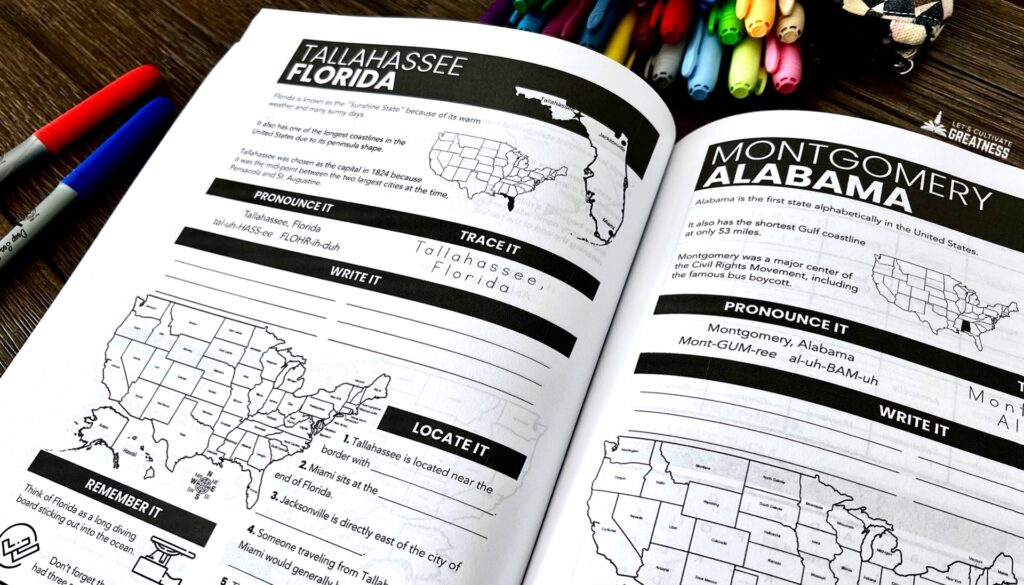
5. Learn Something Else About Each State & Capital
Adding one meaningful detail—such as a geographic feature, major city, or cultural note—makes each state more memorable. The key is that it has to be meaningful, not just random trivia. For example, learning how Georgia’s capital, Atlanta, began as a railroad hub (its first name was even Terminus!) for the South and remains a major airport hub today.
Why this strategy works: This extra context reduces cognitive load by giving students something concrete to associate with a place. When learning feels connected and interesting, retention improves naturally.
Ready-Made Curriculum That Supports These Strategies
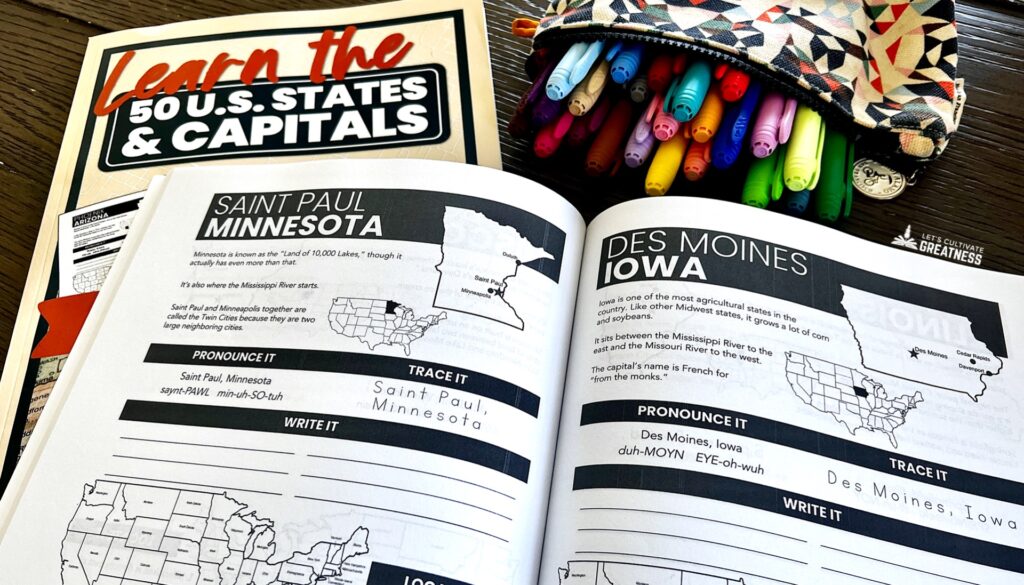
If you want to put these strategies into practice without creating everything from scratch, you’ll want my workbook, Learn the 50 U.S. States & Capitals.
This resource is open-and-go and easy to adapt for different ages, making it useful for both first-time learners and middle- or high-school students who need that refresher. Check out my flip-through video below to see a bit more inside.