One of the best ways to save money on homeschool social studies is to choose an inexpensive “spine,” like a textbook or a lecture-style video series, then add a few free resources to fill in the gaps and bring the subject to life.
The good news is that many excellent free social studies resources exist for middle and high school.
The hard part is deciding which ones to use! And if you’re not familiar with the subject, it’s tough to know what’s good or what’s best for your child. Nobody wants to be looking up dozens of recommendations from all over.
That’s why I’m sharing my shortlist of vetted favorites: interactive games, primary sources, books, documentaries, and more.
Every pick is either free online or commonly available at local libraries, and each one comes with a quick idea for how to use it. If your library doesn’t carry a title, ask about interlibrary loan. Most libraries can borrow it from another system for you, often at no cost.
Choose resources that balance out your spine. Using a video series? Great! Add some print materials and readings. Using a textbook? Also great! Your child might love a few online games to go with it.
Pick just one or two to use at a time, and use them to go deeper on what you’re already studying. That keeps things manageable for both of you.
Jump to: U.S. History | World History | Geography | Civics | Economics
Free U.S. History Resources
For middle school, start with Mission US. For high schoolers, Reading Like a Historian is my top pick.
Mission US Online (account required) | Grades 6–8, interactive game
Your child plays a young person living through a turning point in American history, from 1770 Boston to the Dust Bowl. Their choices shape the story. Some missions cover slavery and incarceration, so preview first. Under 13? Use the free iPad or Chromebook app, which needs no login.
Try this: Afterward, ask, Which choice was hardest, and why?
A History of US by Joy Hakim Library | Grades 6–8, book series
Ten books that tell American history as a story, full of real people and quotes. Kids who think history is boring often change their minds.
Try this: Read one chapter aloud each week alongside the era you’re studying.
DocsTeach Online | Grades 6–8, primary source activities
Ready-made activities built around real documents, photos, and maps from the National Archives, already organized by era.
Try this: Pick one activity from the era you’re studying and do it together.
Reading Like a Historian Online (account required) | Grades 9–12, lessons
Each lesson gives your teen a historical question and a short set of primary sources, then asks them to answer it from the evidence. Created at Stanford, now run by the Digital Inquiry Group.
Try this: Let your teen argue their answer out loud before writing it down.
Ken Burns documentaries Library or PBS | Grades 9–12, documentary series
In-depth series on American history, from The American Revolution to The Vietnam War, built on letters, photos, and interviews. Many libraries carry them on DVD, and some offer them through Kanopy (basically Netflix, but free!).
Try this: After an episode, ask, Whose voices did we hear? Whose were missing?
Free World History Resources
Middle schoolers love DK Eyewitness books, and high schoolers can review the big picture with Crash Course World History.
DK Eyewitness books Library | Grades 6–8, book series
Photo-packed books on ancient Egypt, the Aztecs, knights, and dozens more. Each page is a quick, visual read that kids pick up on their own.
Try this: Check out the matching Eyewitness book at the start of each new civilization.
World History Encyclopedia Online | Grades 9–12, articles and timelines
A nonprofit library of clear, well-sourced articles, maps, photos, and timelines, especially strong on the ancient world.
Try this: Read the timeline for your current civilization together and add three dates to your own.
BBC’s A History of the World in 100 Objects Online | Grades 9–12, podcast
One hundred 15-minute episodes, each telling world history through a single object, from early stone tools to the modern world. It’s audio, so it’s great on car rides!
Try this: After an episode, look up a photo of the object and ask, How did this end up in the British Museum? Should it stay there?
Crash Course World History Online | Grades 9–12, video series
Fast, funny, roughly 10-minute videos with John Green that cover world history from the first farmers to the modern world.
Try this: Watch the episode on your current unit, then have your teen sum up the big idea in one sentence.
Khan Academy World History Online | Grades 9–12, online course
Short videos, readings, and quizzes organized in order, so your teen always knows what’s next.
Try this: Use one unit as a review before moving on to a new era.
Free Geography Resources
Seterra and Dollar Street work at any age, and Prisoners of Geography has editions for both middle and high school.
Seterra Online | Grades 6–12, map quiz game
Hundreds of quick, timed map quizzes on countries, capitals, states, and more. It’s the most painless way I know to build map knowledge.
Try this: Have your child beat their own best time once a week. Five minutes is plenty.
Dollar Street Online | Grades 6–12, photo database
Photos of real homes around the world, from stoves to toothbrushes, sorted by income instead of country. An eye-opening look at how people actually live.
Try this: Pick one item, like “stove,” and scroll from lowest income to highest. What changes?
Google Earth guided tours Online | Grades 6–12, interactive tours
Ready-made tours from scientists, storytellers, and nonprofits on topics like migration, city growth, climate, and Indigenous communities. They’re especially good for human geography.
Try this: Take one tour together when you reach a matching topic, like migration or city growth.
Prisoners of Geography by Tim Marshall Library | Grades 6–12, book
Marshall uses maps to explain why countries act the way they do, from Russia to China to the Middle East. The Illustrated Young Readers Edition works well in middle school, and the original suits high schoolers.
Try this: After a chapter, find one news story it helps explain.
BBC’s Planet Earth Library | Grades 6–12, documentary series
Stunning footage of deserts, mountains, oceans, and jungles. It makes physical geography feel huge and real.
Try this: Pause on one landscape and ask, Could people live here? How?
Free Civics Resources
For middle school, start with iCivics. For high schoolers, Oyez lets them hear real Supreme Court arguments.
iCivics Online (account required) | Grades 6–8, interactive games
Founded by Justice Sandra Day O’Connor, iCivics has free games where your child runs a campaign, argues a case, or balances the three branches.
Try this: Play Do I Have a Right?, then ask which case surprised them.
The Week Junior Library | Grades 6–8, news magazine
A weekly news magazine written for kids, with short, balanced stories on current events. Many libraries carry it.
Try this: Read one story together and ask, Who’s affected, and what might happen next?
Bill of Rights Institute Online | Grades 6–12, videos
Short, clear videos on the Constitution and landmark Supreme Court cases, plus readings with primary sources.
Try this: Watch one case video, then have your child explain the decision in their own words.
Oyez Online | Grades 9–12, Supreme Court cases
Plain-language case summaries plus audio of the actual oral arguments. Hearing the justices question the lawyers makes the Court feel real.
Try this: Listen to a few minutes of Tinker v. Des Moines (a case about student free speech). Have your teen decide how they’d rule, then read the decision.
Interactive Constitution Online | Grades 9–12, annotated Constitution
The National Constitution Center explains every clause through pairs of scholars with different views, who write what they agree on and where they differ.
Try this: Read the essays on one amendment. Which argument is strongest, and why?
Free Economics Resources
Middle schoolers can start with How to Turn $100 into $1,000,000, and high schoolers can start with NPR’s Planet Money podcast.
How to Turn $100 into $1,000,000 by James McKenna and Jeannine Glista Library | Grades 6–8, book
A friendly guide to earning, saving, and investing for ages 10–14, with stories of young entrepreneurs and a business plan template.
Try this: Use the template to plan a small business, like a bake sale, then actually try it.
The FDIC’s Money Smart for Young People Online | Grades 6–12, lessons
Free personal finance lessons by grade band, including guides written for parents.
Try this: Have your child plan a family outing on a set budget.
Federal Reserve Education Online (teacher account) | Grades 6–12, lessons and activities
The Federal Reserve’s free education site has hundreds of economics and personal finance lessons and activities. Parents can sign up for a free teacher account.
Try this: Head to the search filters. Choose your child’s grade level and a topic like “Spending & Budgeting,” then pick one lesson.
NPR’s Planet Money Online | Grades 9–12, podcast
Casual, funny episodes that explain what’s in the news through an economic lens, from sports and pop culture to whatever’s trending. It’s audio, so it’s screen-free!
Try this: Pick an episode on something your teen already cares about, then ask them to explain the big idea back to you.
Naked Economics by Charles Wheelan Library | Grades 9–12, book
A clear, funny explanation of how the economy works, with no graphs or formulas required.
Try this: Read one chapter a week alongside your economics course.
Want more ideas by grade band?
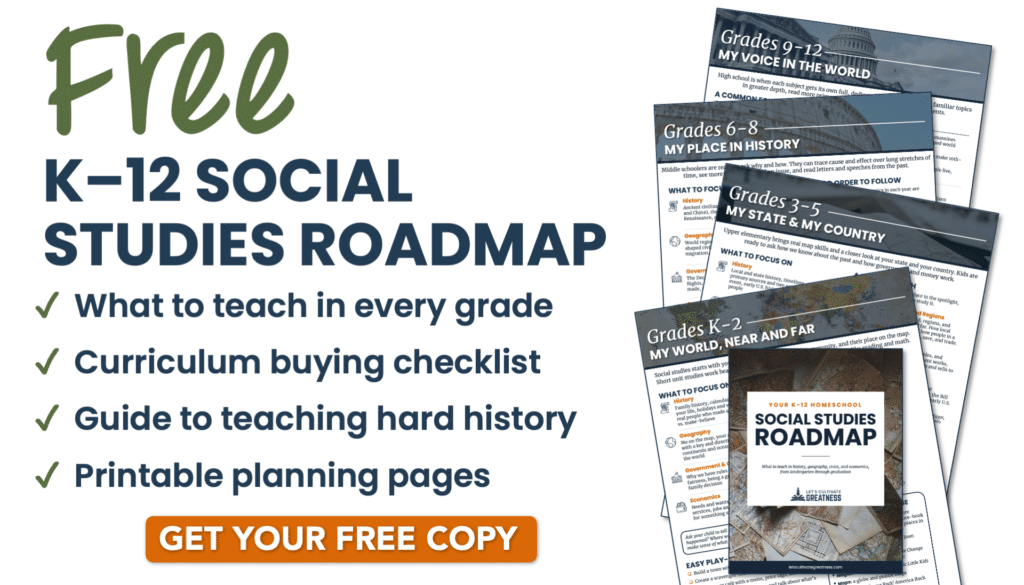
Supplements are easiest to choose when you know what you’re supplementing! My free K-12 Social Studies Roadmap shows what to teach at every grade band, plus a list of books, websites, and resources for each band. It also includes a curriculum buying checklist, a guide to teaching hard history, and printable planning pages.
And if you’re looking for open-and-go, screen-free resources for middle and high school, you can browse my workbooks anytime.