One question I hear from homeschool parents all the time is some version of “What exactly is social studies?” or “What’s the difference between history and social studies?” And these are totally fair questions! The two words often get used as if they mean the same thing.
So here’s the short answer: Social studies is the study of people and how they live together.
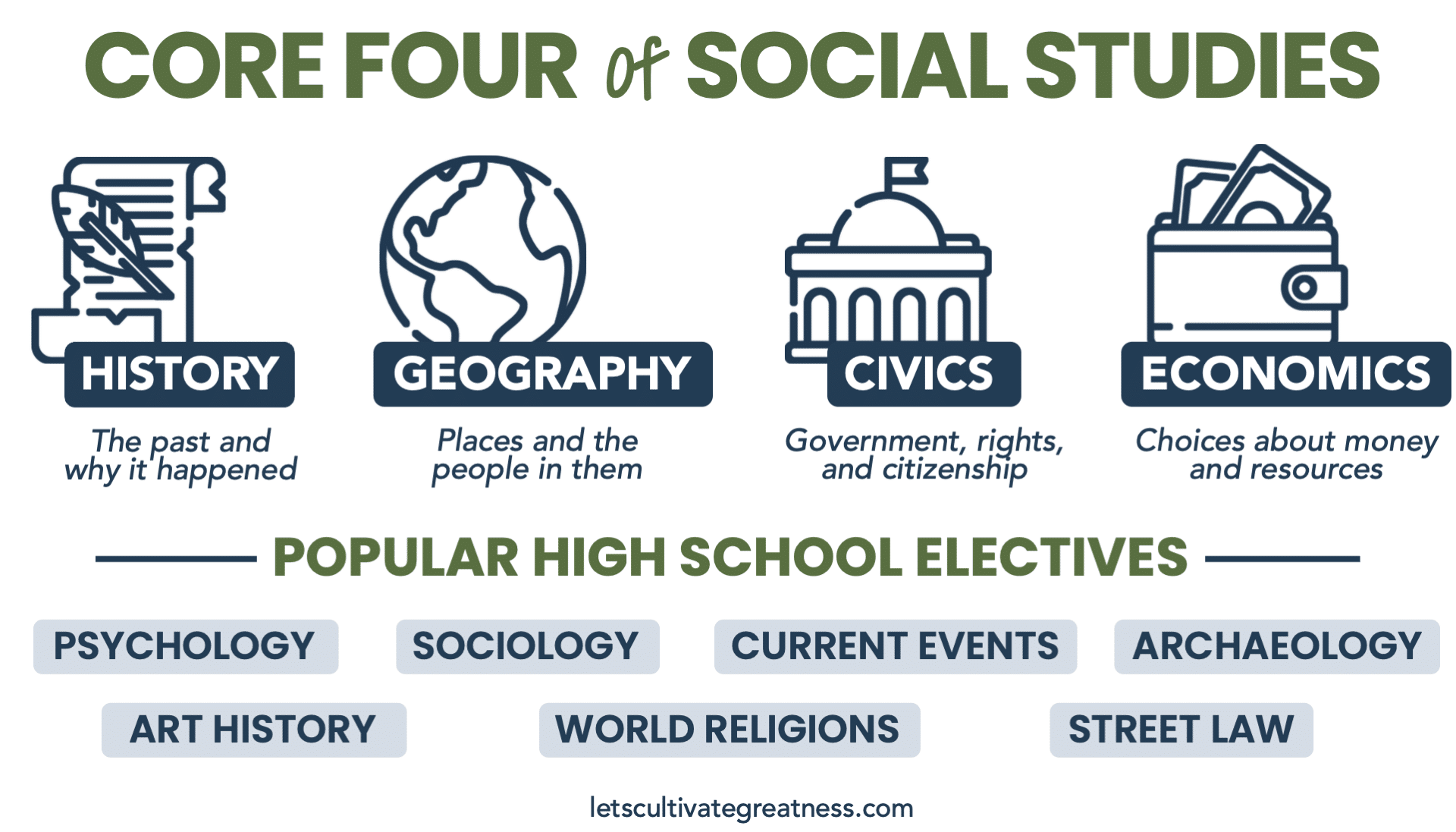
It’s a broad field with several subjects, just as science includes biology, chemistry, and more. Social studies has four main subjects: history, geography, civics, and economics. In high school, your child might also take social studies electives like psychology and sociology.
What social studies looks like also changes as kids grow. Once you know what to look for at each stage, choosing resources gets a lot easier, whether you buy a full course or put together your own.
Is history the same as social studies?
No. History is one of those four subjects. It studies the past, while geography, civics, and economics focus more on how people live today. The four overlap all the time, which is why they get mixed up so easily.
In the early grades, history is one topic among many. Kids might learn about their own family’s history or read picture-book biographies, alongside lessons on communities and simple maps. Around middle school, history becomes more formally taught, studied chronologically, and other subjects get more focused attention, too.
What counts as social studies for homeschool?
All four subjects count, and each one is worth real time on its own. Here’s what each subject covers, and what it can look like at your kitchen table:
History is what happened, why it happened, and how it shaped the world we live in.
At home: building a timeline, reading a biography, or reading a letter written during the Civil War.
Geography is where places are, what they’re like, and how people and places affect each other.
At home: labeling maps, watching a documentary about fast fashion, or looking at population growth graphs.
Civics and government cover how laws are made, how government works, and citizens’ rights and responsibilities.
At home: talking through the Bill of Rights, reading your state’s voter guide together, or watching a local city council meeting online.
Economics is how people make choices with limited money, time, and resources.
At home: planning a grocery budget, creating a savings plan, or sorting the things your family buys into goods and services.
What are examples of social studies activities?
No matter your child’s age, social studies is much more meaningful when you get outside the book (or screen!). You’d never imagine a chemistry course without a single experiment, or an environmental science course that never sent your kid outside. Social studies works the same way.
If you’re not sure what activities you could do, here are a few examples:
- Labeling a blank map from memory, then checking it against an atlas
- Visiting a museum or historic site with a few questions to answer by the end
- Watching the news and talking through the biggest stories: who’s affected, and what might happen next?
- Listening to recordings of presidents’ speeches and inferring how Americans responded at the time
- Planning a detailed road trip budget using real gas and hotel prices, and deciding which attractions to visit
Want more ideas like these? Here are some easy homeschool social studies activities you can try this week.
What should a middle schooler learn in social studies?
Middle school usually moves from the ancient world toward the United States. One common path:
6th grade: ancient civilizations, world geography, or both
7th grade: world history after Rome, plus the basics of economics
8th grade: early U.S. history and civics
At this age, materials usually focus on one historical era for the year and weave all four subjects through it. A 6th grade workbook might cover how Greek city-states governed themselves (civics), how early farming led to trade (economics), and why the Nile mattered so much to Egypt (geography).
It’s still four subjects, just blended. Naming them as you go (“This part is economics!”) helps your child see how they connect.
Middle school is also when questions shift from what and how to why. Why did Rome fall? Why did people settle near rivers? Those why questions are where middle schoolers begin thinking like historians.
Curriculum tip: When comparing materials, notice how much space the four subjects get. If history fills most of the pages and the others only show up in occasional sidebar boxes, you may want to add something for those subjects.
What social studies does my teen need in high school?
Grade-level social studies curriculum generally stops around 8th grade. In high school, subjects split into separate courses, which is why planning can feel trickier.
A common four-year plan looks like this:
9th grade: world geography or human geography
10th grade: modern world history
11th grade: U.S. history, either the full span or since Reconstruction
12th grade: government and economics, often a semester each
High school is also a great time for electives. Courses on topics like current issues, street law, or world religions can also count as social studies credits, and teens often find them pretty fascinating.
Transcript requirements vary quite a bit, so check your state’s homeschool law. If college is on the horizon, look at what the colleges your teen is considering expect, too.
How do I know we’re on track for social studies?
Planning gets much easier when you look at social studies in four grade bands: K-2, 3-5, 6-8, and 9-12.
Each band builds on the one before it, so you don’t have to worry about hitting every topic in a single grade. You just want your child to grow a little deeper with each band.
Take the three branches of government. A 2nd grader might learn who the president is and what a governor does. A 4th grader can name the three branches. An 8th grader can explain how checks and balances work. A high schooler can read a Supreme Court case and debate how it changed the country.
Seeing the whole path helps you know what to focus on this year, and what can wait until later.
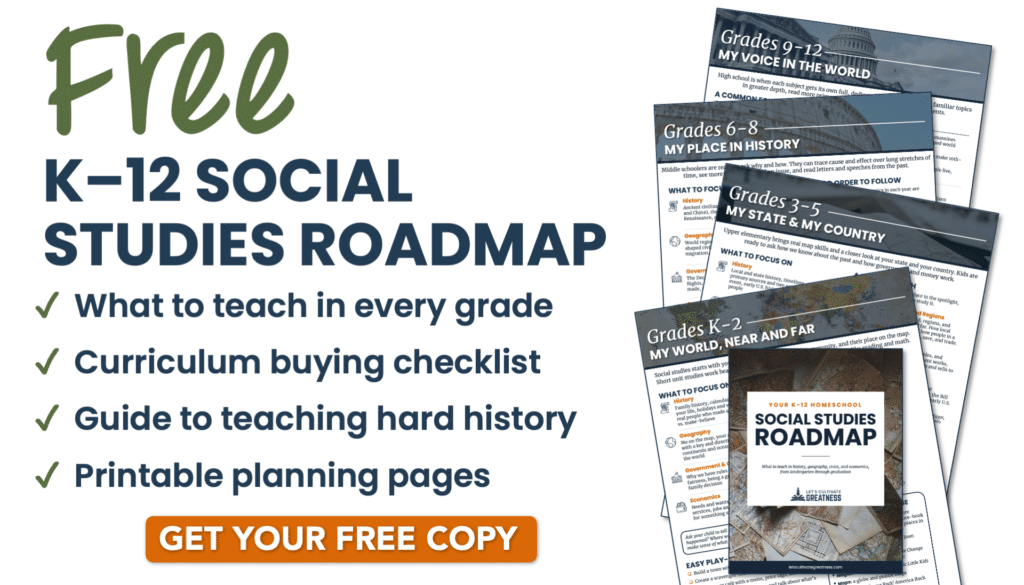
My free K-12 Social Studies Roadmap lays out that path, band by band. It also includes a curriculum buying checklist, a guide to teaching hard history, and printable planning pages.
And if you’re looking for open-and-go, screen-free resources for middle and high school, you can browse my workbooks anytime.